Oil and shavings settle in every corner of your workshop
A workshop gets dirty in a way unlike any other place: oil seeps into concrete or epoxy floors and turns into a black layer that traps metal shavings and fine dust, while grease sticks to the sides of benches, drawers and walls around machinery. The fine dust enters through openings, clings to these layers and makes them harder to shift over time. Workshop cleaning of this kind calls for a different approach from any other space.
Tell us the size of the workshop, what kind of work happens there and what you notice building up, and we agree a time that suits you. Call or message us on WhatsApp and include your district.
- Industrial floors
- Oil sumps and grease
- Walls and ceilings
What does workshop cleaning cover?
These are the surfaces and parts the cleaning goes through in the workshop, depending on its condition and the kind of work done there.
- The industrial floor
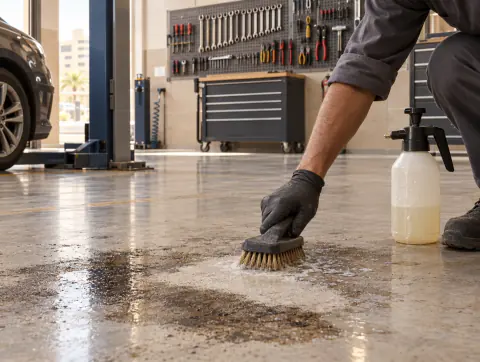
We remove hardened oil and grease layers from concrete or epoxy floors, because the build-up makes them slippery and hides cracks and damage underneath.
- Oil sumps and inspection pits
Oil residue and contaminated water collect in them; we clear both out and clean the pit walls, as neglecting them affects the safety of anyone working inside.
- Workbenches and metal surfaces
We clear grease, surface rust and accumulated shavings from the tops, as these are the most-used areas and build up continuously.
- Walls and columns
Walls near machinery absorb oil vapour over time and develop a greasy layer mixed with dust, which we remove with targeted cleaning.
- Ceilings and beams
Dust and soot collect on steel beams and ceilings and fall back onto equipment; we clear them so they do not resettle on the cleaned surfaces below.
- Internal storage areas
Shelves and areas storing parts and tools gather dust behind stored items; we clean them in a way that suits what is kept there.
How do we start?
Three simple steps, and we take care of the rest.
Call or message us on WhatsApp
Tell us the service you need and your district.
Tell us about the workshop
Tell us the size of the workshop, the type of work done there, what build-up you notice, and which district it is in.
We agree a time and you prepare
We settle on a time that fits your workshop's schedule, and you move tools and sensitive parts away from work areas to give clear access to surfaces.
We work top to bottom
We start at ceilings and beams, move to walls, then the floor and oil sumps. When we finish, check the surfaces and floor yourself to confirm the result.
A service that comes to your door
- We come to youOur team arrives at your home with its equipment.
- One callCall or message us on WhatsApp and we arrange the rest.
- Other services for your facilityWe also handle commercial pest control and commercial post-construction cleaning for newly finished workshops.
- Describe it in your own wordsA call or a WhatsApp message is enough to describe your workshop's condition and agree on what suits it.
One worry is that the workshop will be out of action for a long stretch during cleaning. The areas and approach are agreed with you beforehand so activity can continue in other parts while the work goes on; the details are settled when you call.
Photos of our work




























What our customers say
خدمة ممتاز وسعر مناسب وشغل مية مية انصح فيهم 👍
ثاني تجربة لي معهم ،، يعطيهم العافية
ممتازين جداً وسريعين 👍🏻الف شكر لهم نظفو لي الخزان وعملو عزل كامل والشغل على اكمل وجهه
Questions about Workshop cleaning
When do I know my workshop needs specialist cleaning?
Clear signs include the floor becoming slippery from an oil layer, shavings and dust building up under benches and in corners beyond what daily sweeping handles, and walls near machinery showing a darkening greasy coat. If any of these appear, a full clean is the right step.
How is a concrete workshop floor soaked with oil cleaned?
Concrete is porous and absorbs oil over time, forming a hard layer at the surface with oily material deeper in. The surface is treated first to break the hardened layer before removal. Telling us the workshop's age and activity type helps us decide the right approach when you call.
Do I need to remove equipment and tools before cleaning?
Moving out heavy machinery is not necessary in most cases, but clearing small tools and sensitive parts away from work areas makes surfaces accessible and protects them. Tell us what fixed equipment is in the workshop when you call so we can account for it.
What determines the price of workshop cleaning?
The price depends on the floor area, how heavily oil and grease have built up, whether there are sumps or inspection pits to deal with, and how accessible the different areas are. Share these details when you call and we agree on what suits you.
Can a workshop that runs continuously be cleaned without a full shutdown?
In most cases the workshop can be divided into zones and each cleaned separately, agreed with you before starting. Planning the sequence in advance reduces the effect on production; the details are worked out when you call.
Related services
Have a look at services close to this one.