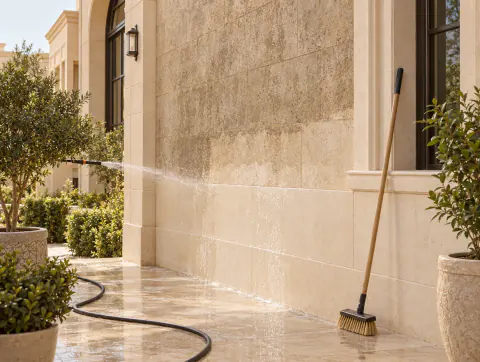
Stone absorbs what touches it and the marks stay
Stone is a porous surface, and that is what gives it its natural look, but it also means it absorbs fine dust, moisture and the salts carried in the wind. These materials build up quickly, especially through the summer and after dust storms, leaving dark lines along the edges of each stone, white salt patches and yellowing on exposed surfaces.
Call or message us on WhatsApp, tell us your district, the type of stone and what you can see on the facade, and we agree a time that suits you. We assess the stone's condition first, because the method differs between natural stone such as limestone or travertine and artificial or composite cladding panels.
- Natural and artificial stone
- Stains and yellowing
- Salt and dust deposits
What does stone facade cleaning cover?
These are the parts and stages the work goes through on a stone facade, depending on the surface condition, the type of stone and the height of the building.
- Stone type assessment
We identify the stone type before starting, because limestone is sensitive to acids, travertine has wide pores and artificial stone has a different outer layer; the type determines the right cleaning method.
- Dry dust and deposits
We remove the dry dust layer and loose surface deposits first, because leaving them during wet cleaning turns them into silt that blocks the stone's pores.
- Salt stains and yellowing
White patches on stone are usually salts rising from the concrete behind it through the pores, while yellowing comes from iron oxidation within the stone's composition; treating each one requires a different approach.
- Edges and joints
Dirt and biological growth collect along joints and at the edges of each stone block more than anywhere else, and we give them particular attention because they are clearly visible from ground level.
- Shaded and exposed faces
Shaded faces on a stone facade behave differently from those in direct sun: shaded areas retain moisture and grow thin green algae, while sun-exposed faces yellow, dry out and can crack.
- Final check
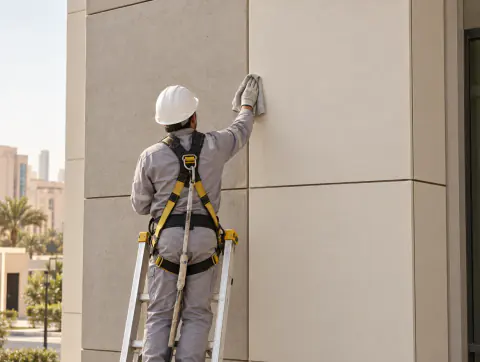
After cleaning we check with you that the stone colour is even, that the joints are clean and that no white residue remains on the surface.
How do we start?
Three simple steps, and we take care of the rest.
Call or message us on WhatsApp
Tell us the service you need and your district.
Tell us what you notice
Tell us the stone type if you know it, what you see in terms of stains, yellowing or darkening, the height of the building and which district you are in.
We agree a time and you prepare
We settle on a time that suits you, and you let residents on floors facing the facade know to keep their windows closed during the work.
We work and you check
We assess the stone then clean the facade stage by stage, and when we finish you check the colour is even and the joints and surfaces are free of any residue.
A service that comes to your door
- We come to youOur team arrives at your home with its equipment.
- One callCall or message us on WhatsApp and we arrange the rest.
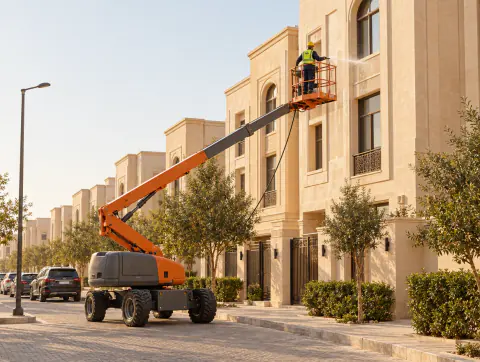
- Other facade types with the same teamWe also clean glass facades, cladding, shopfronts and villa facades, and we provide lifts and drone cleaning for high-rise facades.
- Describe it in your own wordsA call or a WhatsApp message is enough to describe what you see on your stone facade.
One worry is that strong cleaning might scratch the stone or change its colour for good. Stone varies widely in hardness and composition, which is why we identify the type and condition before taking any step, not after. Tell us what you see and leave the rest to us.
Photos of our work




























What our customers say
سرعة في الخدمة والإنجاز
١٠/١٠ ما شاء الله
الله يعطيهم العافيه شغل محترف و نظيف و يعطونك نصايح تفيدك من خلال خبرتهم انصح بتجربتهم ماراح تندمون
Questions about Stone facade cleaning
How do I know if my stone facade needs cleaning rather than repair?
If the problem is staining, darkening or yellowing on the surface, cleaning is the right first step. If the stone is cracked, separating from the wall or losing powder, that points to a fixing or backing issue, which is a different matter. Tell us exactly what you see and we will guide you.
Where do the white patches on my stone facade come from?
They are usually salt crystals rising from the concrete or building materials behind the stone through its pores, a process called efflorescence. It intensifies after rare rain or humid spells. Removing it is different from removing ordinary dust, and we account for it during the facade assessment.
What should I prepare before stone facade cleaning?
Let residents on floors facing the facade know to close their windows during the work. If there are outdoor AC units or downpipes attached to the facade, mention them when you call so we can work around them carefully.
Is artificial stone cleaned the same way as natural stone?
No, artificial stone or composite panels are made from different layers and are often less porous. Some carry a surface coating that can be affected by methods suited to natural stone. That is why we ask for the stone type when you call before deciding on the method.
What should I check on the facade after stone cleaning?
Check that the stone colour is even across the full facade and that there are no noticeably lighter or darker patches. Inspect the joints between the stones and confirm they are free of white residue. If you notice anything unusual, let us know before the team leaves.
Related services
Have a look at services close to this one.