Grease rises and settles inside your ceiling extractor
A ceiling extractor is fixed above eye level, which means grease building up on its inner housing and fan blades goes unnoticed for a long time. Steam from cooking carries grease upward, and it clings to the metal or plastic surfaces of the unit, thickening layer by layer until the fan begins to labour and the noise level rises.
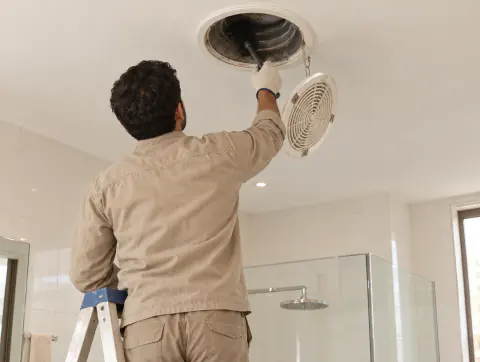
We start by hearing what you have noticed about your extractor, then we remove the cover, clean the housing, the fans and the duct walls, and check that the outlet passage is clear. Call or message us on WhatsApp, tell us your district and how the extractor is behaving, and we agree a time.
- Housing and cover
- Fans and motor
- Duct and outlet
What does ceiling extractor cleaning cover?
These are the parts the cleaning goes through in a ceiling extractor, depending on its condition and how long grease has been building up.
- The outer cover
We remove the cover and clear the layer of grease and dust from its surface, as it is the first part to catch rising grease from the hob.
- The inner metal housing
The interior walls of the extractor collect layers of grease, and we remove them fully so the surface is clean and air moves through freely.
- The fan blades
Grease sticks to the fan blades and upsets their balance, which causes vibration and noise, so we clean each blade individually to bring the fan back to steady rotation.
- The shaft and base
The fan base and shaft trap heavy grease that drips from the blades, and we remove it to stop it building up and straining the motor.
- The duct walls
The duct carries air out of the kitchen, and its walls coat with grease over time, narrowing the passage and weakening the draw, so we clean them to the extent access allows.
- The outlet and vent
We check that the extractor's air outlet in the ceiling or wall is not blocked, since any restriction there pushes the greasy air back into the kitchen.
How do we start?
Three simple steps, and we take care of the rest.
Call or message us on WhatsApp
Tell us the service you need and your district.
Tell us what you notice
Tell us if the extractor is noisy, drawing weakly or has not been cleaned in a long time, and which district you are in.
We agree a time
We settle on a time that suits you, and it helps to clear the area below the extractor of utensils and items so there is room to reach it.
We start the work
We remove the cover and clean the housing, fans, duct and outlet, then switch the extractor on with you to check the draw is stronger and the noise has dropped.
A service that comes to your door
- We come to youOur team arrives at your home with its equipment.
- One callCall or message us on WhatsApp and we arrange the rest.
- All kitchen services with one teamWe clean hood filters, kitchens, home appliances and restaurant hoods too.
- Describe your extractor in your own wordsA call or a WhatsApp message is enough to tell us what your extractor is doing.
One worry is taking the extractor apart and putting it back correctly, and that is a normal part of the cleaning process, with the cover returned to its place at the end. Tell us what you notice about your extractor and leave the rest to us.
Photos of our work




























What our customers say
ماشاءالله شغل نظيف وخدمه حلو
افضل شركة تنظيف
افضل شركه تنظيف منازل وخزانات بارك الله فيكم
Questions about Ceiling extractor cleaning
How do I know the ceiling extractor itself needs cleaning, not just the filter?
If the fan has started making a noise or vibrating in a way it did not before, or you smell grease from the extractor even while it runs, the build-up is likely on the fan blades and inner housing, not on the filter alone. The filter catches what reaches it first, but some grease passes through and settles on the surfaces behind it.
Does the extractor being high in the ceiling change how the work goes?
Yes, the height of the extractor affects how it is reached and how the work goes. Tell us when you call where it is and roughly how high, so we can prepare accordingly and agree the details with you.
Why does the fan get louder over time even though the extractor still works?
The fan is designed to run in balance, and grease settles on its blades unevenly over time, which upsets that balance and creates a vibration that shows as noise. As grease thickens on the blades and shaft, the load on the motor increases. Cleaning the blades restores the balance and eases the strain.
Do I need to turn off the gas or electricity before the cleaning?
It is sensible to cut power to the extractor's circuit before work starts, and that is normal practice when working on any ceiling electrical fitting. Gas is not usually directly connected to a ceiling extractor, but tell us anything relevant about your kitchen when you call so we come prepared.
What should I check after the ceiling extractor is cleaned?
Switch the extractor on and listen to the fan: it should be quieter and steadier than before. Hold your hand near the intake and check that the draw feels stronger. Also look at the external outlet if you can reach it to confirm it is clear.
Related services
Have a look at services close to this one.