School surfaces are touched again and again every day
The handle on the classroom door, the surface of the desk, the tap in the toilet, the banister on the stairs: all of these pass between students' hands and stay contaminated without showing a visible sign. Dust settles on horizontal surfaces, and heavy repeated use builds up on high-touch points before anything looks noticeably wrong.
We start by hearing the details of the school: its area, the number of classrooms and the zones that need sanitizing. Call or message us on WhatsApp, tell us your district and the nature of the space, and we agree a time that suits you.
- Classrooms and corridors
- Desks and doors
- Toilets and entrances
What does school sanitizing cover?
These are the zones and surfaces the sanitizing goes through, depending on the school's size and how it is used.
- Classrooms
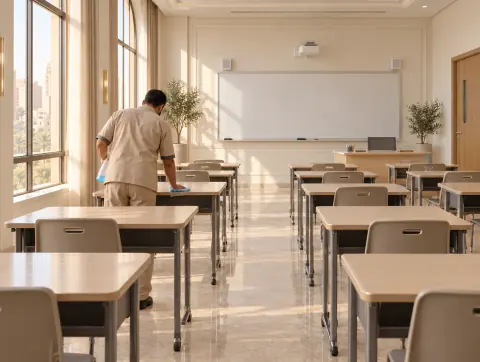
We sanitize the surfaces of desks, tables, boards and floors, since this is the space students spend most of the day in and where handprints and dust accumulate.
- High-touch points
Door and window handles and light switches are the most frequently touched surfaces in a school and carry contamination well beyond what their small area suggests.
- Toilets and taps
Wet surfaces in toilet blocks are among the highest-contamination zones in any school building and need a different approach from the dry surfaces in classrooms.
- Corridors and stairs
All student movement between lessons passes through them, and the banisters and floors take continuous pressure throughout the school day.
- Entrances and reception
The first surfaces visitors and parents touch when entering the building, and they carry contaminants in from outside and into the rest of the school.
- Canteen or waiting area
Service counters and shared tables pass through many hands in a short time and call for sanitizing that is handled separately from the dry surfaces in classrooms.
How do we start?
Three simple steps, and we take care of the rest.
Call or message us on WhatsApp
Tell us the service you need and your district.
Tell us about the school
Tell us the school's area, the number of classrooms and which zones need sanitizing, and which district it is in, so we can agree on what suits it.
We agree a time
We choose a time that suits you, often after school hours or during a break, and you make sure the classrooms are clear and all the required zones are accessible.
We work and you check afterwards
We sanitize the agreed zones one by one, and you check the high-touch points and the surfaces that needed attention before the next school session starts.
A service that comes to your door
- We come to youOur team arrives at your home with its equipment.
- One callCall or message us on WhatsApp and we arrange the rest.
- Other sanitizing services with the same teamWe also handle Home sanitizing, Clinic sanitizing, Hospital sanitizing, Operating-theatre sanitizing, Restaurant sanitizing, Spray sanitizing, Ozone sanitizing and UV sanitizing.
- Describe the space in your own wordsA call or a WhatsApp message is enough to explain the school's size and which areas need sanitizing.
A common worry for anyone responsible for a school is how sanitizing can happen without disrupting lessons or closing the building for a long time. We agree the timing with you and organise the work zone by zone so the school day is not affected. Leave the coordination to us.
Photos of our work




























What our customers say
الشركه اكثر من رائعه نظافه تامه وتعامل ودقه في العمل والحرص على رضا العميل. يعطونك الصور قبل وبعد للتاكد. اوصي فيهم جدا .
افضل شركه تنظيف منازل وخزانات بارك الله فيكم
مره ينظفو من قلب والله
Questions about School sanitizing
How do I know the school needs sanitizing rather than ordinary cleaning?
Cleaning removes visible dirt, while sanitizing treats what stays on surfaces after cleaning. A school needs sanitizing when it reopens after a long holiday, when student absences for health reasons increase, or before a new term starts after a break.
What surfaces do I prepare before the team arrives to sanitize the school?
It helps to clear desks of books, bags and personal items, leave classroom cupboards accessible, remove food and drink from the canteen area, and make sure the toilet blocks are accessible.
Does sanitizing classrooms differ from sanitizing the toilet blocks?
Yes. The dry surfaces in classrooms such as desks and floors are treated differently from the wet surfaces in toilet blocks. The moisture in toilets keeps surfaces more prone to contamination, and they need separate treatment suited to that environment.
Can part of the school be sanitized without the rest of the building?
Yes, it is possible to agree on sanitizing specific zones only, such as classrooms alone, toilet blocks, or the entrance. We ask you when you call which areas you want treated and organise the work accordingly.
What changes the scope of work in school sanitizing?
The building's area and number of classrooms, the number of floors and the length of corridors, the type of surfaces including floors, walls and furniture, and the condition of the building and the level of visible contamination: all of these affect the scope, and we agree the details after you describe the space.
Related services
Have a look at services close to this one.